What is landing page?
Landing page definition
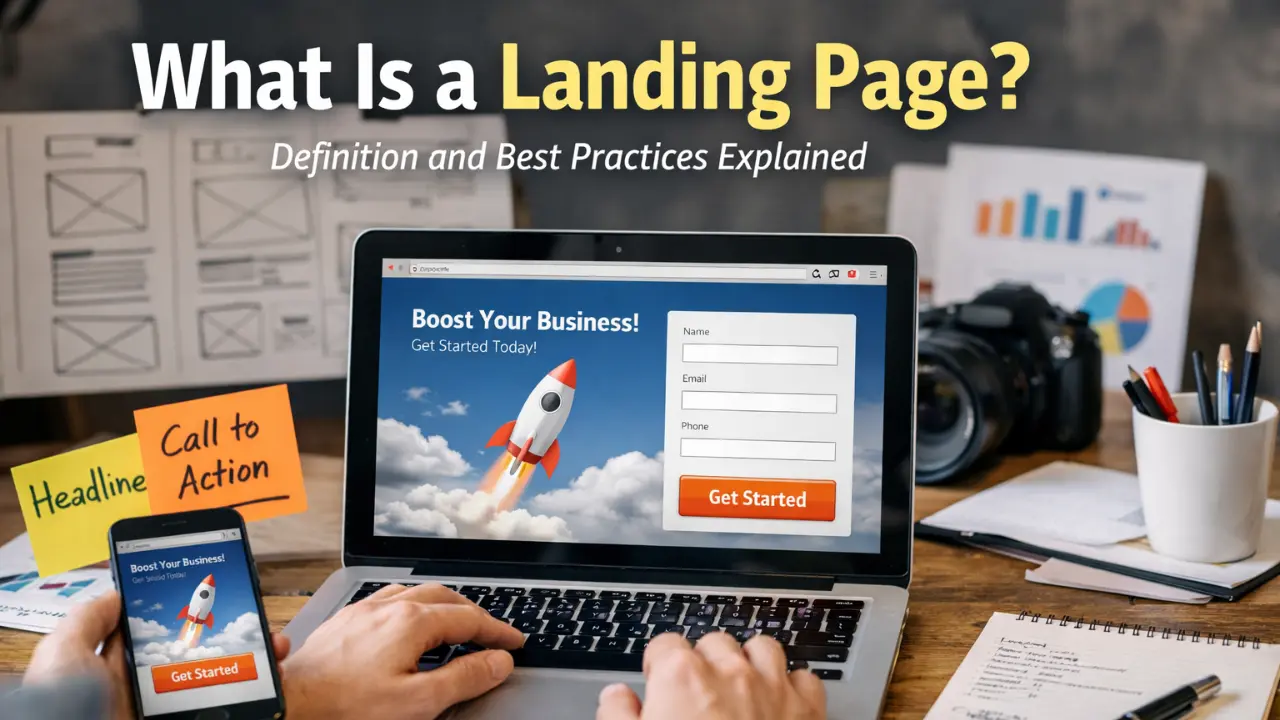
A landing page is a standalone web page created specifically for a marketing or advertising campaign where visitors arrive after clicking on a link in an email, paid advertisement, search engine result, or social media promotion. The page serves a single, focused purpose designed to drive a specific visitor action, such as capturing lead information, promoting product purchases, or encouraging event registrations.
Unlike standard web pages that encourage exploration and provide multiple navigation options, landing pages eliminate distractions and concentrate exclusively on achieving one conversion goal. Every element on the page works toward prompting visitors to complete a specific call-to-action (CTA), whether filling out a form, making a purchase, booking a demonstration, or downloading content. This singular focus distinguishes landing pages from other web content and accounts for their effectiveness in marketing campaigns.
Marketers use landing pages as targeted entry points tied directly to specific campaigns, audiences, or promotional offers. The page content functions as a logical extension of the advertisement or link that brought visitors there, maintaining message consistency and reinforcing the initial promise. Businesses measure landing page success through conversion rates, with effective pages achieving a median conversion rate of 6.6% across industries.
Landing page vs homepage: key differences
The homepage serves as a brand’s digital gateway, providing a comprehensive overview of the business, multiple navigation paths, and access to various site sections. Visitors can explore products, read company information, access resources, or navigate to specific areas based on their interests. Homepages typically feature extensive navigation menus, numerous links throughout the content, and multiple CTAs that guide users to different parts of the website.
Landing pages operate with an opposite approach, removing navigation bars and limiting links to maintain visitor focus on a single conversion objective. Whereas homepages attract traffic from broad sources like organic search, social media shares, and direct visits, landing pages connect directly to paid advertising campaigns, email promotions, and targeted marketing initiatives. The homepage informs visitors about the entire business; the landing page promotes one specific offer, product, service, or event.
Navigation structure represents a critical distinction between these page types. Homepages include full navigation menus allowing visitors to explore freely, while landing pages intentionally omit navigation bars to prevent distractions from the primary goal. This focused design approach results in higher conversion rates for landing pages compared to homepages, which cater to wider audiences who may browse without immediate intent to convert. The homepage encourages exploration and brand discovery; the landing page drives immediate action on a specific offer.
Types of landing pages
Lead generation landing page
A lead generation landing page captures visitor contact information in exchange for valuable resources such as ebooks, webinars, free trials, or consultations. The primary goal involves collecting email addresses and relevant data to build relationships with prospects before converting them into paying customers. Businesses typically offer lead magnets (free resources) that solve specific audience problems or provide educational content aligned with their products or services. The average conversion rate for lead generation landing pages reaches 18%, though optimized pages paired with compelling offers achieve conversion rates exceeding 70%. These pages commonly include forms requesting names, email addresses, and occasionally demographic information like company name or industry for B2B applications.
Click-through landing page
Click-through landing pages function as intermediary pages between advertisements and conversion destinations such as shopping carts or checkout pages. These pages provide detailed product or service information without requiring form submissions, instead featuring prominent call-to-action buttons that direct visitors to complete transactions elsewhere. The purpose centers on warming visitors to the value proposition and building interest before requesting commitment. Software companies frequently use click-through pages to promote free trials, presenting feature benefits and usage context to convince prospects to progress through the marketing funnel.
Squeeze page
A squeeze page represents a specific landing page type designed exclusively to capture email addresses through minimal, focused design. Unlike broader lead generation pages, squeeze pages contain no navigation links, limited text, and simple forms requesting only email addresses (sometimes with names). These pages achieve notably higher conversion rates, with examples demonstrating performance between 35% and 41%. The absence of exit paths forces visitors to either submit information or leave, creating focused decision points. Squeeze pages typically offer newsletters, downloadable content, discount codes, or webinar access as incentives for email submission.
Sales landing page
Sales landing pages utilize long-form content to present detailed product or service pitches supported by testimonials, videos, and multiple calls-to-action throughout the page. These pages target prospects at the bottom of the sales funnel, requesting payment rather than just contact information. The extended format allows comprehensive explanation of complex products, addressing objections and building persuasive cases for purchase through extensive copywriting and visual elements.
Event landing page
Event landing pages promote conferences, webinars, or meetups while facilitating registration or ticket purchases. These pages include essential event details such as date, time, location, speakers, and agenda alongside registration forms. Effective event pages convey value propositions for attending, often incorporating countdown timers, past event imagery, and partner logos to build credibility and urgency for sign-ups.
Benefits of using landing pages
Higher conversion rates
Online advertising campaigns utilizing landing pages demonstrate conversion rate improvements of at least 25% compared to campaigns without dedicated pages. Testing multiple landing page versions can double this performance gain, substantially increasing the return on marketing investment. The focused nature of landing pages eliminates competing pathways and distractions present on homepages, where visitors encounter numerous links that dilute conversion potential. Message match between advertisements and landing pages maintains momentum from the initial click, ensuring visitors find the exact offer promised in the promotional material rather than navigating through site architecture to locate relevant information.
Better lead generation
Dedicated landing pages capture more qualified leads than directing traffic to homepages, with organizations experiencing a 55% increase in leads when expanding from 10 to 15 landing pages. Each page serves a specific audience segment or campaign goal, allowing businesses to tailor content precisely to visitor expectations and needs. Landing pages enable prospect data tracking beyond initial conversion, providing demographic insights and behavioral patterns that inform future marketing strategies. The ability to create multiple pages for different campaigns permits fine-tuned audience targeting, with each page addressing distinct pain points and offering relevant solutions that resonate with specific buyer personas.
Improved campaign tracking
Landing pages simplify analytics by presenting only one possible action for visitors to complete, creating binary measurement scenarios where users either convert or exit. Campaign-specific reporting becomes straightforward when a single page handles all traffic from a particular source, eliminating the tracking complexity inherent in homepage analytics where 40 or more links create numerous potential pathways[131]. The absence of competing information on the page enhances accuracy in attributing conversions to specific marketing efforts. Testing changes to standalone landing pages requires less organizational coordination than modifying homepages, allowing rapid iteration and validation of customer assumptions through A/B testing frameworks.
Targeted messaging
Customized landing pages align user experience directly with marketing objectives by matching content to the specific traffic source and audience segment. This precision reduces bounce rates by meeting visitor expectations established through advertisements or promotional links. The freedom to design pages independent of website architectural constraints enables experimentation with messaging, imagery, and layout optimized for campaign performance rather than brand consistency requirements. Targeted approaches help businesses understand which message types, visual elements, and information formats their customers value most, informing broader marketing strategies beyond individual campaigns.
Key elements of a high-converting landing page
Clear and compelling headline
Five core elements distinguish high-converting landing pages from underperforming variants. The headline functions as the initial point of contact, with research indicating users form opinions about websites within 0.05 seconds. Effective headlines communicate the unique selling proposition while addressing visitor pain points or desired outcomes through specific, benefit-oriented language. Well-crafted headlines can lead to 3x higher conversion rates by immediately answering the visitor’s implicit question regarding value. The headline must maintain consistency with the traffic source that directed users to the page, reinforcing the promise made in advertisements or promotional materials rather than introducing new concepts.
Strong call-to-action
The call-to-action represents the conversion mechanism where visitors transition from passive observers to active participants. Action-oriented language specifying the exact outcome (such as “Start My Free Trial” rather than “Submit”) increases engagement by clarifying what visitors receive in exchange for their clicks. Visual contrast through bold colors distinguishing the CTA from page backgrounds ensures the element captures attention, while strategic placement aligns with user intent at decision-making moments. Clear, specific CTAs boost conversion rates by up to 161% compared to generic alternatives.
Optimized forms
Form optimization balances information collection with user willingness to complete submissions. Research demonstrates that using three form fields results in a 10% conversion rate, with the most common combination requesting first name, last name, and email address. Forms should request only essential information relevant to business needs, accompanied by privacy statements providing reassurance about data security and GDPR compliance.
High-quality visuals
Visual content accelerates comprehension and strengthens emotional connections with visitors. Landing pages incorporating video can increase conversions by 86%, as videos demonstrate products in action more effectively than static imagery. Authentic, high-resolution photographs outperform generic stock images by building credibility and maintaining user engagement.
Social proof and trust signals
Social proof leverages psychological phenomena wherein people reference peer behaviors during decision-making processes. Pages incorporating reviews convert nearly four times better than pages without them, with research showing social proof can increase conversions by up to 270%. Effective implementations include customer testimonials with photographs and full names, third-party review scores from platforms like G2 or Capterra, recognizable client logos, and case studies demonstrating quantifiable results.
Landing page best practices
Keep design simple and focused
Simplifying design eliminates distractions that prevent visitors from completing desired actions. Cluttered layouts overwhelm users and disperse attention across competing elements rather than directing focus toward conversion goals. Strategic whitespace emphasizes critical components like headlines and CTAs, while limiting images and avoiding animations prevents page slowdown. The attention ratio concept measures links against conversion goals; effective landing pages maintain a 1:1 ratio, presenting one call-to-action without alternative navigation paths that dilute user focus.
Make it mobile-friendly
Responsive design ensures pages adapt properly across device sizes, preventing distorted layouts and unreadable text that frustrate users. Buttons and interactive elements require minimum dimensions of 48×48 pixels with adequate spacing to accommodate thumb navigation and prevent accidental clicks. Google’s mobile-first indexing prioritizes mobile content versions for ranking, making mobile optimization essential for search visibility alongside conversion performance.
Use A/B testing
Testing one variable at a time establishes clear cause-and-effect relationships between design changes and conversion outcomes. Marketers experiment with CTA placement, copy formatting, visual elements, and form length to identify performance drivers. Statistical analysis determines winning variations, transforming optimization from opinion-based decisions into data-informed strategies.
Optimize page speed
Pages loading under 3 seconds demonstrate optimal performance, as bounce rates increase dramatically beyond this threshold. Image compression, code minification, and content delivery networks reduce load times by decreasing file sizes and serving content from geographically proximate servers.
Match message to traffic source
Aligning landing page copy with advertisement phrasing reassures visitors they reached the intended destination. Message match reduces bounce rates while improving Google Ads quality scores, which lower cost-per-click rates and improve ad positioning. Each traffic source benefits from dedicated landing pages that maintain consistent messaging throughout the customer journey.
FAQs
Q1. What exactly is a landing page?
A landing page is a standalone web page specifically designed for marketing or advertising campaigns. It’s where visitors arrive after clicking on links from emails, paid ads, search results, or social media promotions. Unlike regular web pages, landing pages focus on a single goal—getting visitors to take one specific action, such as filling out a form, making a purchase, or signing up for an event.
Q2. How is a landing page different from a homepage?
A homepage serves as your website’s main gateway with multiple navigation options and links to various sections. In contrast, a landing page removes navigation menus and limits distractions to keep visitors focused on one conversion goal. While homepages provide a broad overview of your business, landing pages are tied to specific campaigns and promote one particular offer, resulting in higher conversion rates.
Q3. What are the essential elements that make a landing page convert well?
High-converting landing pages include five key elements: a clear, compelling headline that communicates value within seconds; a strong call-to-action with specific, action-oriented language; optimized forms that request only essential information; high-quality visuals like authentic images or videos; and social proof such as customer testimonials, reviews, and recognizable client logos that build trust and credibility.
Q4. Why should businesses use dedicated landing pages instead of directing traffic to their homepage?
Landing pages deliver significantly higher conversion rates—at least 25% better than campaigns without them. They capture more qualified leads, with businesses seeing a 55% increase in leads when expanding their landing page count. Landing pages also simplify campaign tracking by focusing on one action, enable targeted messaging for specific audiences, and allow for easier testing and optimization without affecting your main website.
Q5. What are the most important best practices for creating effective landing pages?
Keep your design simple and focused with a 1:1 attention ratio (one call-to-action without competing links). Ensure mobile-friendliness with responsive design and properly sized buttons. Use A/B testing to optimize elements like headlines and CTAs based on data. Optimize page speed to load under 3 seconds, and always match your landing page message to the ad or link that brought visitors there to maintain consistency and reduce bounce rates.